
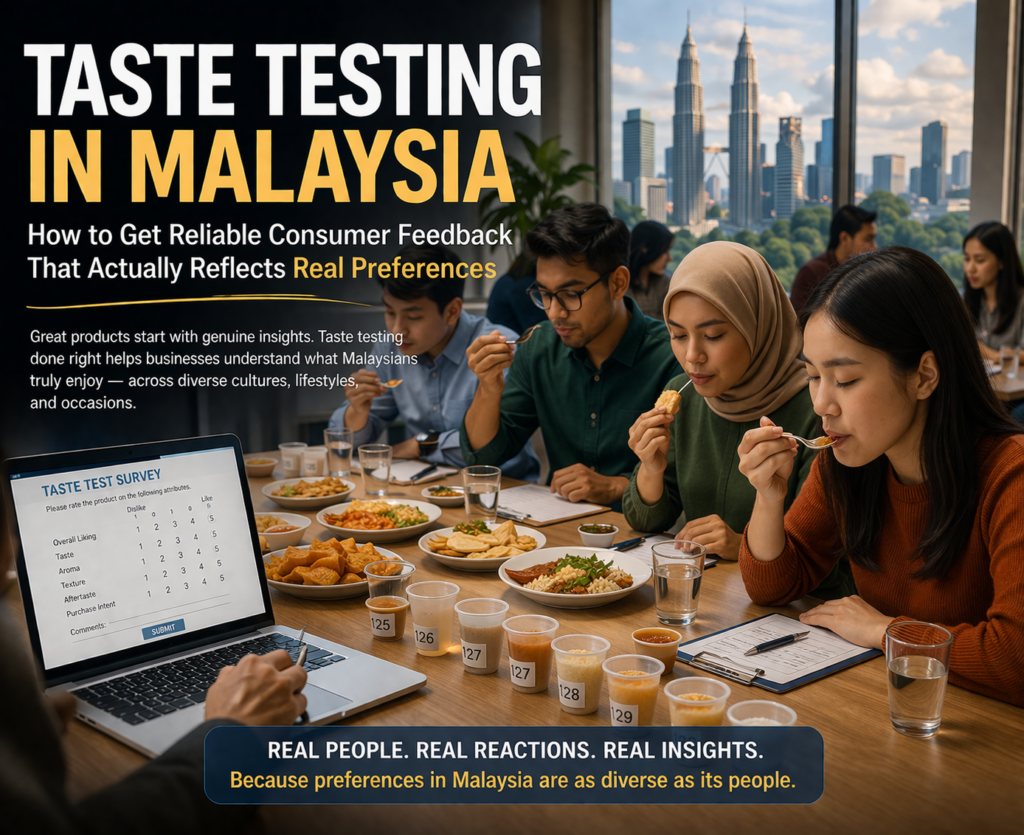
Taste Testing in Malaysia: How to Get Reliable Consumer Feedback That Actually Reflects Real Preferences
Mar
Taste Testing in Malaysia: How to Get Reliable Consumer Feedback That Actually Reflects Real Preferences
Taste testing is one of the most widely used methods in FMCG research. It is often seen as straightforward: prepare samples, recruit participants, collect feedback, and compare results. In practice, it is far more sensitive than it appears.
Small details in execution can significantly influence outcomes. When not controlled properly, results may reflect the testing environment rather than true consumer preference. In Malaysia, where food preferences are diverse and culturally influenced, getting taste testing right requires careful design.
What Taste Testing Is Really Measuring
At its core, taste testing is not just about whether a product is liked. It is about understanding:
- How a product compares to alternatives
- Whether it meets consumer expectations
- What specific attributes drive preference
These attributes can include taste intensity, texture, aroma, and aftertaste. A well-designed test isolates these factors so that results are meaningful and actionable.
The Importance of Controlled Environments
One of the most critical aspects of taste testing is consistency. Every participant should experience the product under the same conditions. This includes:
- Portion size
- Temperature of the sample
- Order in which samples are presented
- Time between tastings
If these variables are not controlled, results can become inconsistent. For example, a product served slightly warmer or later in the sequence may be rated differently, even if the product itself is unchanged.
Blind Testing vs Branded Testing
A key design decision in taste testing is whether to reveal the brand.
Blind testing removes brand bias and focuses purely on product attributes. This is especially useful for product development and benchmarking. Branded testing reflects real-world perception and captures the influence of brand and packaging, making it useful for go-to-market decisions.
Both approaches serve different purposes. Choosing the right one depends on the objective of the study.
Managing Order Bias
The sequence in which samples are presented can influence perception. This is known as order bias. Common effects include the first sample setting expectations, later samples being compared against earlier ones, or fatigue affecting how subsequent samples are evaluated.
To minimise this, researchers often rotate sample order across participants, limit the number of samples per session, and provide palate cleansers between tastings. These steps help ensure that each product is evaluated more independently.
The Role of the Moderator
In Malaysia, taste testing sessions are often guided by a moderator. The moderator’s role is not just to facilitate, but to ensure consistency by explaining evaluation criteria clearly, ensuring participants follow instructions, and avoiding leading or influencing responses.
Cultural Context Matters
Taste preferences in Malaysia are shaped by a mix of cultural influences. Differences may exist across ethnic groups, regional backgrounds, and dietary habits. For example, preferences for sweetness, spice, or texture can vary significantly, and familiarity with certain ingredients affects how products are perceived.
This makes it important to recruit a representative sample and analyse results by segment where relevant. A single overall score may hide meaningful differences between groups.
Common Mistakes in Taste Testing
Some of the most common issues in taste testing come from execution rather than design. These include:
- Inconsistent sample preparation across sessions
- Too many samples in a single session, leading to fatigue
- Lack of clear evaluation criteria
- Mixing different product formats without proper control
From Preference to Actionable Insight
Taste testing should not stop at identifying which product is preferred; the real value lies in understanding why. This involves breaking down ratings by specific attributes, identifying what drives liking or disliking, and linking sensory feedback to potential product improvements. Knowing that a product performs better because of texture but weaker on aftertaste is an actionable insight.
When to Use Taste Testing
Taste testing is particularly useful for:
- Product development and reformulation
- Comparing variants or formulations
- Benchmarking against competitors
- Pre-launch validation
Closing Thoughts
Taste testing requires a high level of control and attention to detail to produce reliable results. In Malaysia’s diverse food landscape, this becomes even more important. When executed properly, taste testing provides clear, actionable insights that can guide product decisions with confidence.
About Central Force International Sdn Bhd
Central Force International (CFI) is Malaysia’s leading homegrown market research agency, specialising in comprehensive data collection services since 1996. As a trusted partner and member to global organisations such as ESOMAR and WAPOR, we are dedicated to delivering high-quality, ethical, and impactful research insights. With in-house teams for data processing, quality control, and research, CFI ensures every project meets the highest standards of excellence. Visit us at www.cforce-int.com to learn more.