
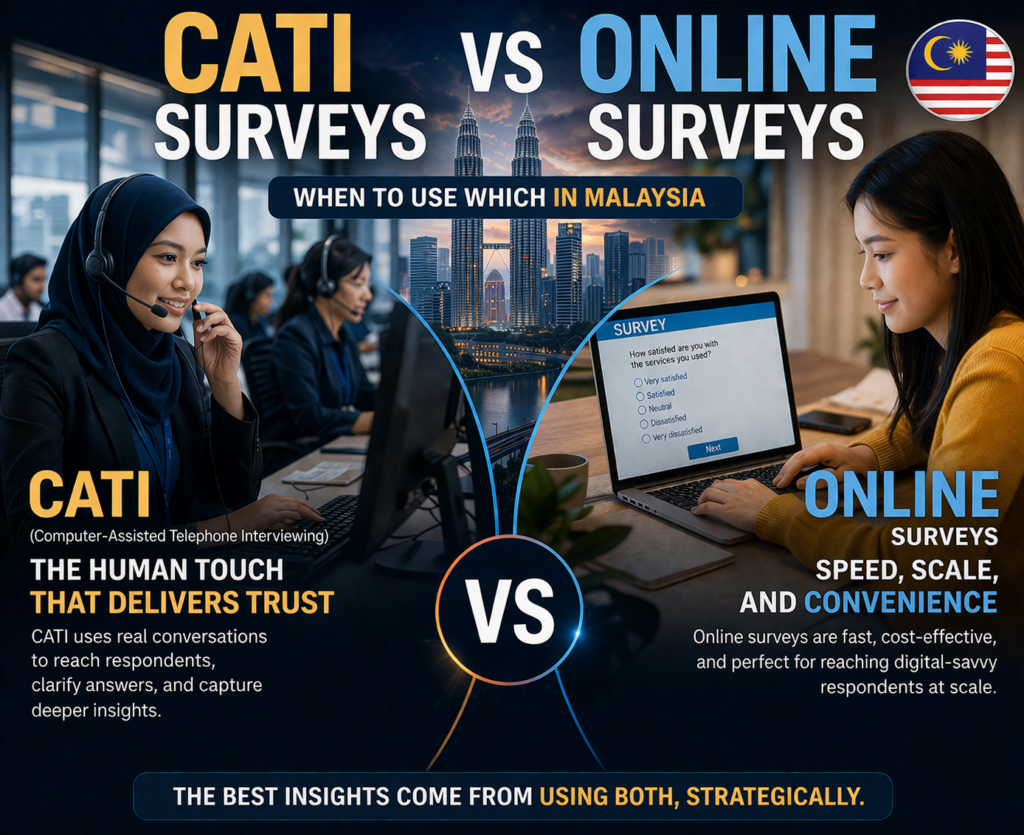
CATI vs Online Surveys: When to Use Which in Malaysia
Mar
When planning a research project, one of the first methodological decisions is often framed as a simple choice: should we use telephone surveys (CATI) or online surveys? In practice, this is rarely a binary decision. Each method has its strengths, limitations, and ideal use cases. Choosing the wrong one does not just affect cost or speed; it affects who is represented in the data and how reliable the findings are. In Malaysia, where population diversity and digital behaviour vary across segments, this choice becomes even more important.
Understanding the Two Approaches
CATI, or Computer-Assisted Telephone Interviewing, involves trained interviewers conducting surveys over the phone. Online surveys, on the other hand, are self-completed by respondents, typically through panels, email invitations, or digital channels. The difference lies in how data is collected and how much control the researcher has over the process.
Where CATI Performs Better
CATI is often the preferred method when representativeness is critical. Because respondents are actively contacted, it allows for broader reach across age groups (including older populations), lower digital adoption segments, and rural or semi-urban areas. It also provides more control during the interview itself. Interviewers can:
- Ensure questions are understood correctly
- Probe or clarify when needed
- Enforce screening criteria more strictly
This makes CATI particularly useful for nationwide population studies, public opinion research, and studies where accuracy is more important than speed. The trade-off is that CATI requires more time and operational resources.
Where Online Surveys Excel
Online surveys are designed for speed and scalability. They are effective when targeting digitally active consumers, urban populations, and specific segments already accessible online. They also allow for faster turnaround times, lower cost per respondent, and easier deployment across large sample sizes.
However, they come with limitations. Because participation is self-driven, there is less control over how questions are interpreted, the level of respondent engagement, and whether respondents fully meet screening criteria. This can introduce bias if not managed carefully.
The Risk of Choosing Based on Convenience
A common mistake is selecting methodology based purely on cost or speed. For example, using online surveys for a nationwide study may under-represent less digitally active groups, while using CATI for a niche, digitally focused audience may be inefficient. The method should always follow the objective; a mismatch can lead to data that appears complete but does not accurately reflect the intended population.
Key Differences That Matter in Practice
| Feature | CATI (Telephone) | Online Surveys |
|---|---|---|
| Control | Greater control over who is interviewed | Less control over respondent engagement |
| Authenticity | Higher confidence in respondent identity | Dependent on panel quality and screening |
| Coverage | Better across diverse/rural populations | Best for digitally active/urban groups |
| Speed & Cost | Higher cost and slower collection | Lower cost and faster turnaround |
Why Hybrid Approaches Are Increasingly Common
In many cases, the most effective solution is a hybrid approach that combines both methods. For example, CATI can be used to anchor the sample and ensure representativeness, while online surveys scale responses efficiently. This allows researchers to balance coverage, cost, speed, and data quality. In Malaysia, hybrid methodologies are becoming more common as research needs become more complex.
What This Means for Clients
Methodology should be a strategic decision because it directly influences who is included in the study and how confidently decisions can be made. Organizations should ask:
- Who are we trying to represent?
- What level of accuracy do we need?
- How quickly do we need the results?
Closing Thoughts
CATI and online surveys are not competing methods; they are complementary tools. In Malaysia’s diverse research environment, the ability to choose the right method—or combine them effectively—often determines whether a study delivers insight or just data.
About Central Force International Sdn Bhd
Central Force International (CFI) is Malaysia’s leading homegrown market research agency, specialising in comprehensive data collection services since 1996. As a trusted partner and member to global organisations such as ESOMAR and WAPOR, we are dedicated to delivering high-quality, ethical, and impactful research insights. With in-house teams for data processing, quality control, and research, CFI ensures every project meets the highest standards of excellence. Visit us at www.cforce-int.com to learn more.