
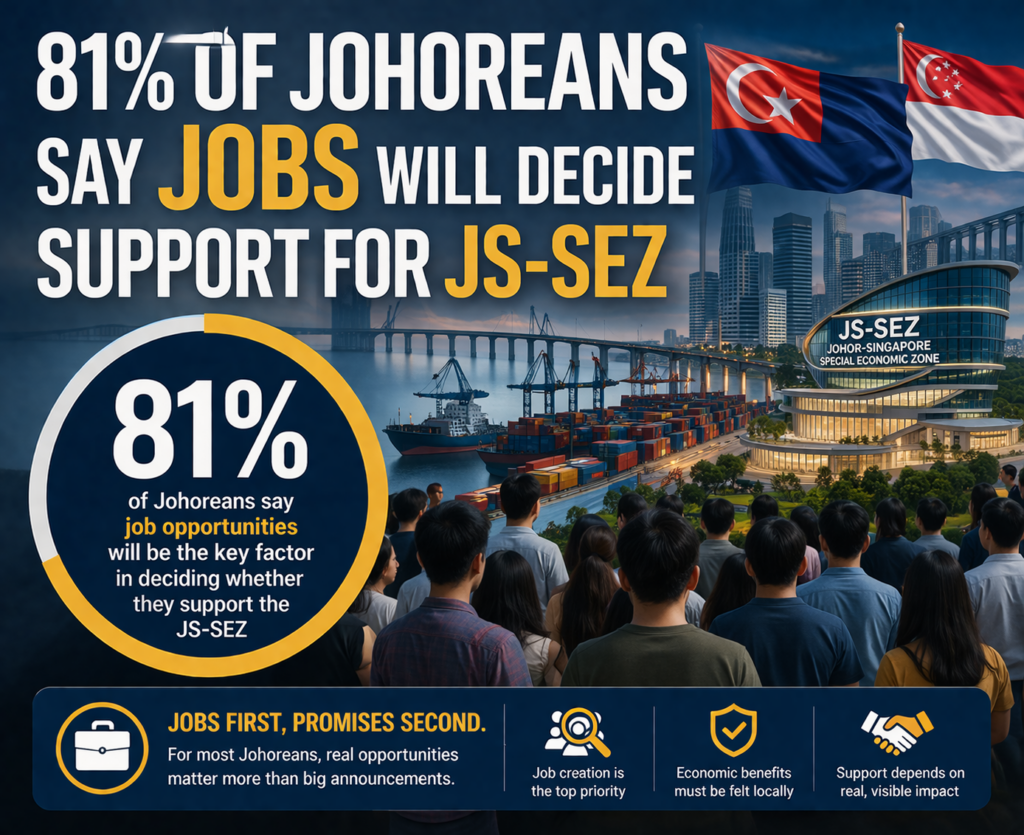
81% of Johoreans Say Jobs Will Decide Support for JS-SEZ
Mar
New study shows backing is conditional as cost-of-living and housing concerns shape sentiment ahead of the Master Plan launch.
Kuala Lumpur, 10 March 2026 –
Central Force International’s latest public sentiment study released ahead of the anticipated 30 March 2026 JS-SEZ Master Plan announcement, shows that while support for the Johor Singapore Special Economic Zone remains broadly positive, it hinges on whether development translates into tangible gains for local residents, especially with regard to employment opportunities and housing affordability.
The study reveals that 81.4% of Johoreans cite job creation for locals as the primary condition for supporting the initiative, followed by affordable housing (70.1%), traffic planning (47.3%), environmental management (32.5%), and improved public amenities (30.5%). This suggests that optimism does exist, but it is structured, pragmatic, and outcome-driven.
Investment Momentum Recognised, but Awareness Gap Persists
Approved investments linked to the JS-SEZ have reportedly reached RM37.1 billion within six months. However, findings from the first chapter of Central Force International’s Public Sentiment Report allude to the fact that 64% of Johoreans remain unclear about what the initiative entails or how it affects them directly.
Among those who are aware, the initiative is most commonly associated with:
- Technology and innovation centres (23.8%)
- Industrial parks (18.6%)
- Tourism-related development (18.0%)
- Housing and property (17.7%)
- Business or commercial hubs (12.5%)
“Investment figures alone do not automatically translate into public confidence,” shared See Toh Wai Yu, Chief Executive Officer of Central Force. “The public interpret the JS-SEZ through tangible factors they can see, work in, or experience directly, highlighting the need for effective communication and sequencing and how it plays as crucial of a role as capital inflows.”
Cost of Living Emerges as Core Risk Variable
While support remains positive, residents are evaluating the initiative through everyday economic pressures.
Top concerns cited included:
- Increased cost of living (21.6%)
- Rising property prices (13.8%)
- Traffic congestion (11.5%)
- Governance and policy continuity (9.8%)
Notably, 37.8% of respondents selected “Don’t know” when asked about their concerns, suggesting that public perception is still in formation. In large-scale economic zones, early-stage ambiguity often reflects informational gaps rather than opposition, making communication, sequencing and visible outcomes critical to consolidating long-term support.
“The strongest signals in data relate to cost of living and housing, showing that households are evaluating the initiative in practical terms and assessing whether development will improve or strain their daily economic realities,” said Wai Yu.
Early signs of renewed property activity in Johor highlight why housing has become a key condition for public support. As investment gathers momentum, the focus shifts from whether development is welcomed to whether housing and opportunity will remain accessible for local residents.
What This Means for Johor
As a whole, findings suggest that Johor’s challenge is no longer attracting capital, but converting investment momentum into sustained public confidence.
“With nearly 38% of respondents still uncertain, this is a critical clarity window,” said See Toh Wai Yu. “The Master Plan is not just a sectorial blueprint but a confidence signal. Clear commitments on local hiring, housing affordability and infrastructure sequencing will determine whether uncertainty consolidates into support.”
In large-scale transformation programmes, confidence strengthens when benefits are tangible and predictable. The long-term success of the JS-SEZ will depend less on headline investment figures and more on whether growth is inclusive, clearly communicated and economically manageable for households.
Implications for Government and Businesses
The findings reposition the JS-SEZ as more than an investment corridor, but more so a public test of how large-scale economic transformation is executed.
For policymakers, the issue is no longer ambition but credibility. Delivery timeliness, institutional consistency and policy coordination will shape whether the initiative is perceived as durable rather than cyclical.
For businesses, social license will increasingly function as a competitive advantage. Companies that align with local workforce development, urban planning priorities and long-term community integration are likely to face lower friction and stronger reputational positioning.
In this context, the JS-SEZ is not only an economic platform. It is a confidence platform, and how it is executed will influence Johor’s broader investment narrative for years to come.
View the lite report at
https://www.cforce-int.com/latest-insights.
The full report is available via subscription.
Central Force International is a member of the American Association for Public Opinion Research (AAPOR) Transparency Initiative (TI) and is currently the only Malaysian research organisation participating in this initiative.
— End —